When a lift stops between floors with people inside, the security guard is usually the first person who can respond. A clear lift entrapment procedure helps the guard keep the passengers calm, get the right help quickly and avoid the mistakes that turn a breakdown into an injury.
This guide covers what a security guard should do step by step, what a guard must never do, when to call the fire brigade, and what housing societies and building managers should put in place before a lift emergency happens.
Why a Lift Entrapment Procedure Is a Security Team Job
Most residential and commercial buildings in Mumbai depend on lifts, and many towers have 20 floors or more. When a lift stops, the people inside cannot help themselves, and the lift company’s technician may take some time to arrive.
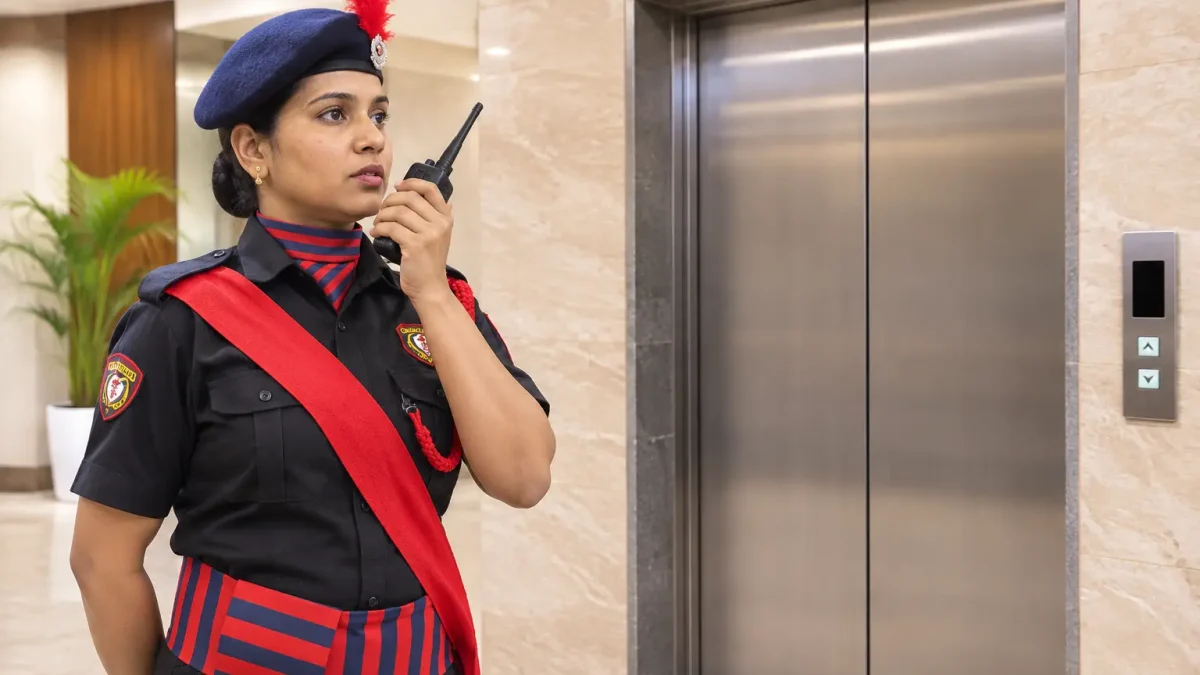
The security guard is on site around the clock, knows the building, holds the emergency numbers and can talk to the people inside. That makes the guard the first responder. It does not make the guard the rescuer. The most important part of any lift entrapment procedure is understanding that difference: guards communicate, call for help and keep people safe, while trained technicians or firefighters carry out the rescue.
What Security Guards Must Never Do
Lift manufacturers and fire services give the same advice: untrained people trying to free passengers cause injuries and damage lifts. Every guard should know these rules before anything else.
- Never force the landing doors or the cabin doors open. The cabin can move unexpectedly, and the gap between the cabin and the shaft is where serious injuries happen.
- Never use the emergency door-release key unless trained and authorised to do so. That key is meant for the lift technician or the fire brigade.
- Never help people climb out of a cabin stopped between floors. Even if the doors are partly open, there is a real risk of a fall into the shaft.
- Never reset, switch off or restart the lift from the machine room or control panel unless the lift company has trained and authorised that guard.
- Never tell passengers to jump, push or rock the cabin to get it moving.
Under any sensible lift entrapment procedure, the guard’s job is to keep the people inside calm, get the right help on the way quickly, and keep everyone else safe until that help arrives.
The Lift Entrapment Procedure: Step by Step
When a guard hears the lift alarm, receives an intercom call or is told that someone is stuck, this is the sequence to follow.
- Confirm the situation. Find out which lift it is, which floor it has stopped at or near, and how many people are inside. Ask whether anyone is injured, unwell, elderly, pregnant, a young child, or has a heart, breathing or anxiety condition.
- Talk to the people inside straight away. Use the lift intercom if it works, or speak clearly through the landing door nearest the cabin. Tell them who you are and that help is being called.
- Ask them to press the door-open button. If the cabin has stopped level with a floor, the doors may simply open. This is the only rescue step a guard should suggest.
- Call the lift maintenance company’s emergency number. Say clearly that people are trapped, as entrapments are treated as priority calls. Give the building address, the lift number and a phone number they can call back on.
- Call the fire brigade if any warning sign is present (see the next section). In Mumbai, the fire brigade number is 101, and 112 works across India.
- Inform the supervisor, the society secretary or the building manager. They may need to coordinate with families or the lift company.
- Stop people from using the other lifts if the fault could be shared, for example during a power fluctuation, and place an “Out of order” notice on every floor where possible.
- Stay in contact with the people inside until they are out. Give them an update every few minutes, even if it is only that the technician is on the way.
- Keep the lobby clear for the technician or firefighters, and send someone to meet them at the gate.
- Record the incident in the occurrence register once everyone is out.
A guard who follows this lift entrapment procedure calmly will handle most breakdowns without anyone getting hurt.
Talking to People Who Are Trapped
How the guard speaks makes a real difference. Panic builds quickly in a small, closed cabin, especially with children or anyone who is claustrophobic. A few things help:
- Introduce yourself by name and stay on the line or at the door.
- Reassure them that lifts are designed with air circulation, so they will not run out of air.
- Ask them to sit down if they can, move away from the doors and not try to open them.
- Give honest updates. “The technician is 20 minutes away” is better than “five minutes” if that is not true.
- Ask someone inside to keep an eye on anyone who seems unwell.
- If a passenger has a medical condition, ask what they need and pass that information to the fire brigade.
When to Call the Fire Brigade Immediately
The lift company can handle most entrapments. But a good lift entrapment procedure also says when not to wait. A guard should call the fire brigade at once, without waiting for the technician, if:
- Anyone inside is injured, unwell, unconscious or having a panic attack they cannot control
- There is smoke, a burning smell or any sign of fire
- The lift dropped suddenly or made unusual noises before stopping
- Water is entering the lift pit or shaft
- Young children, elderly people or a pregnant woman are inside and distressed
- The lift company cannot be reached, or its technician cannot arrive within a reasonable time
- The people inside have stopped responding
When calling, give the exact address, the lift number, the floor, the number of people inside and any medical concerns. Then send someone to the gate to guide the fire engine in.
Lifts and Fire: Part of Every Lift Emergency Procedure
During a fire alarm or an actual fire, lifts become dangerous. Shafts can fill with smoke, power can fail mid-journey and doors can open onto an affected floor. Building fire safety plans generally require residents and staff to use the stairs.
Security guards have a key role here. During an alarm, guards should stop people from using the lifts, direct them to the stairs and help elderly residents or people with limited mobility. Where a building has a fire lift, it is for firefighters only. Guards who have completed fire safety training, such as the module at our security guard training centre, should know their building’s evacuation route and assembly point well before an emergency.
Monsoon and Power Cuts: Two Mumbai-Specific Risks
Water in the lift pit
During heavy rain, basements and lift pits in low-lying areas can take on water. Water in the pit can damage a lift’s electrical parts and cause it to stop or behave unpredictably. If a guard sees water entering the pit, the lift company should be informed immediately and the lift taken out of service until it has been checked. Nobody should use a lift with water in its pit.
Power cuts
Many modern lifts have an automatic rescue device that brings the cabin to the nearest floor and opens the doors during a power cut. Older lifts may not. As part of the lift entrapment procedure, guards should know which lifts in their building have this feature, whether the building’s DG set powers the lifts, and how long it takes to start. After a power cut, the guard should check every lift and call out on each floor to confirm nobody is stuck.
Daily Lift Checks Guards Can Do on Their Rounds
Guards do not maintain lifts, but they pass them several times a shift. A quick check on each round helps catch problems before someone gets stuck in a lift, and it supports the lift entrapment procedure by making sure the alarm and intercom actually work:
- Does the alarm bell work, and can it be heard at the security cabin?
- Does the intercom or emergency phone inside the cabin connect to the security cabin?
- Is the emergency light inside the cabin working?
- Are the lift licence and the maintenance company’s emergency number displayed?
- Is the lift stopping level with each floor, or leaving a step?
- Are there unusual noises, jerks or doors that close too hard?
- Is anyone overloading the lift, for example with furniture on a shifting day, construction material during renovation, or large groups after a function?
Anything unusual should be noted in the register and reported to the supervisor and the building manager the same day.
What Building Managers and Society Committees Should Put in Place
A guard can only follow a lift entrapment procedure properly if the building has prepared for one. Committees and facility managers should make sure that:
- The lift company’s 24×7 emergency number is displayed at the security cabin, in the lift lobby and inside each cabin.
- Every lift is licensed and under an active maintenance contract. In Maharashtra, lifts are regulated under the Maharashtra Lifts, Escalators and Moving Walks Act, 2017, and the licence should be displayed.
- A written lift entrapment procedure is part of the guards’ post orders, covering who to call, in what order, and what not to do.
- The intercom and alarm in each lift connect to a place that is staffed at all hours, not to an empty office.
- Every guard, including relief guards, is briefed on the lift entrapment procedure. A relief security guard covering a weekly off should know it as well as the regular guard does.
- Key contacts are listed: the secretary or building manager, the lift company, the fire brigade and the nearest hospital.
- Lift breakdowns are reviewed every month. Repeated stoppages in the register are an early sign that the lift needs a thorough inspection.
This applies equally to housing societies, office buildings, hotels and hospitals. In a hospital, a stalled lift may be carrying a patient on a stretcher, so the procedure needs to be even tighter. Reliable residential security services and commercial property security services treat lift emergencies as part of the job, not as someone else’s problem.
Recording the Incident
The last step of the lift entrapment procedure is the record. Once everyone is out, the guard should write a short entry in the occurrence register covering:
- Date, the time the lift stopped and the time the passengers were freed
- Which lift, and where it stopped
- The number of people inside and any injuries
- Who was called, at what time, and when they arrived
- What the technician or fire brigade said caused the stoppage
- Whether the lift was taken out of service
This record helps the committee or building manager hold the lift company to account, spot repeat faults and show what action was taken if questions come up later.
How United Guard Force India Prepares Guards for Building Emergencies
At United Guard Force India, every guard goes through emergency response and fire safety training at our own centre in Mumbai before deployment. When we take on a building, we agree written post orders with the society or management, and site-specific emergency steps such as the lift entrapment procedure, the evacuation route and key contact numbers can be included in them. A dedicated supervisor briefs relief guards on these procedures and reviews incidents with the client every month.
We have provided security guards to housing societies, offices, hotels and hospitals across Mumbai, Navi Mumbai and Thane since 1995. If you want to review how your building’s guards would handle a lift emergency, or need a lift entrapment procedure written into your post orders, you can contact us through our security guard services page for a site assessment.
FAQs:-
What is the lift entrapment procedure for a security guard?
Talk to the people inside straight away, ask them to try the door-open button, and call the lift company’s emergency number. Call the fire brigade at once if anyone is unwell or injured, or if there is smoke or water in the shaft. Stay in contact with the passengers until they are out, and record the incident afterwards.
Can a security guard open the lift door to rescue people?
No, unless the guard has been trained and authorised by the lift company. Forcing doors or using the emergency release key without training can cause serious injuries, especially if the cabin has stopped between floors. Rescue should be left to the lift technician or the fire brigade.
Who should be called first: the lift company or the fire brigade?
Usually the lift company, because entrapments are a priority for them and their technician knows the equipment. Call the fire brigade (101 in Mumbai, or 112) immediately if there is any injury, medical concern, smoke, fire or water in the pit, or if the lift company cannot respond in time.
Is it safe to stay inside a stuck lift?
Yes. Lifts are designed with air circulation, and the safest place to wait is inside the cabin, away from the doors. The danger comes from trying to climb out, not from waiting.
Should guards stop people using lifts during a fire alarm?
Yes. During a fire alarm, residents and staff should use the stairs. Guards should direct people away from the lifts and help anyone who needs assistance to evacuate.