

The False Sense of Security That CCTV Creates
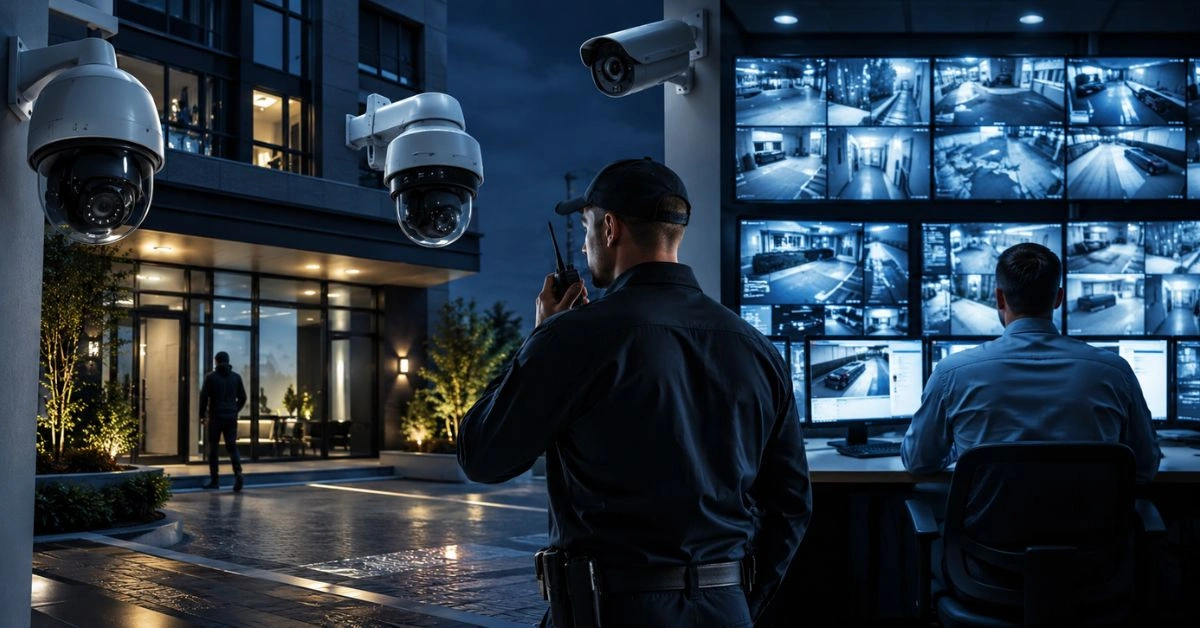
CCTV cameras are passive tools. They record what happens, but they do not prevent what is about to happen. A thief who understands this knows that the camera above the entrance is no barrier at all – it is simply a device that will document his crime after the fact, not stop it in the moment. That is why many property owners combine surveillance systems with security guards for commercial properties, creating a visible human presence that can deter suspicious activity before it escalates.
Security researchers and law enforcement agencies have repeatedly highlighted that surveillance footage is most often used for post-incident investigation, not active threat prevention. By the time the footage is reviewed and acted upon, the damage – theft, vandalism, trespass, or worse – has already been done.
- 67% of burglaries occur at properties with visible CCTV but no on-ground security.
- 3–8 minutes is the average response time after a CCTV alert — enough time for significant loss.
- 40% of criminals report that CCTV did not deter them when no security guard was present.
Key Limitations of CCTV in Modern Property Security
1. Cameras Record — They Do Not Respond
The most fundamental flaw of CCTV-only security is that there is no real-time human intervention. A camera captures an intruder entering your warehouse at 2 AM. It records every second of the break-in with perfect clarity. But it cannot unlock a door, raise an alarm loud enough to wake a neighbourhood, call the police, or physically stop the individual from loading your equipment into a truck. Documentation is not deterrence.
2. Blind Spots Are Inevitable
No matter how many cameras a system includes, blind spots exist. Walls, pillars, stairwells, loading bays, parking lot corners — every property has areas that fall outside camera coverage. Experienced criminals are known to study camera placements before a job. They move through uncovered zones deliberately, exploiting the gaps that every fixed-camera system creates by design.
Important: A comprehensive security audit consistently reveals that even well-designed CCTV installations leave 15–30% of a commercial property’s perimeter uncovered. These gaps are not always visible to the owner — but they are visible to those who want to exploit them.
3. System Failures Go Unnoticed
CCTV systems require consistent maintenance — lens cleaning, cable checks, storage backups, software updates. In practice, many systems operate with cameras that have been offline for days or weeks without the owner’s knowledge. A camera displaying a static image, a disconnected DVR, or a full storage drive is a security system that only appears to be working. The false confidence it provides can be more dangerous than having no system at all. Trained security personnel provide active intervention — something no camera can replicate.
4. CCTV Cannot Identify Suspicious Intent
A camera sees a person walking through your gate. It cannot assess whether that person belongs there, whether their behaviour is suspicious, or whether they are conducting reconnaissance for a future attack. Trained security personnel make these judgments in real time through observation, experience, and direct interaction. The human element of security intelligence cannot be replicated by a lens.
5. Remote Monitoring Has Critical Gaps
Many property owners opt for remote monitoring services as a middle-ground solution. A monitoring station watches your feeds and calls the police if something looks wrong. But consider the chain of events: the monitoring operator must notice the incident, assess it, make a call, and then wait for police response — which in urban India can range anywhere from five minutes to well over thirty minutes. In that window, an organised group can empty a warehouse, a vandal can cause irreversible damage, or a trespasser can inflict serious harm.
What Criminals Actually Think About Your CCTV
Experienced criminals study security setups before making a move. Visible CCTV with no physical presence is often interpreted as minimal risk – the camera will record, but no one is watching in real time, and no one will arrive in time to stop them. The deterrence value of CCTV drops sharply when there is no human security presence to back it up.
This is not speculation. Studies across security literature and interviews with law enforcement confirm that the presence of security guards – uniformed, visible, and active – is among the single most powerful deterrents to property crime. A criminal who sees a camera will look for blind spots. A criminal who sees a trained guard will, in most cases, leave entirely. This is why businesses increasingly invest in commercial security guard services alongside surveillance systems, creating both active deterrence and rapid on-site response.
The Real Gaps: What a CCTV-Only Setup Misses
Critical Security Functions That CCTV Cannot Perform
- Physical access control — Verifying visitor identity, managing entry and exit, and turning away unauthorised individuals at the gate.
- Real-time threat intervention — Physically confronting or detaining a suspect, raising an immediate alarm, or calling emergency services on the spot.
- Patrol and perimeter checks — Walking the property at irregular intervals to detect tampering, trespass, or hazards that cameras cannot detect.
- Emergency response coordination — Acting as the first responder in medical emergencies, fire incidents, or violent situations until official help arrives.
- Behavioural assessment — Identifying suspicious behaviour, unusual patterns, or social engineering attempts that no algorithm can reliably flag in real time.
- Visitor and vehicle logging — Maintaining accurate records of who enters and exits, which is critical for accountability and post-incident investigation.
An Integrated Security Approach: The 2026 Standard
Leading security professionals no longer think in terms of CCTV versus manpower. The question has shifted: how do technology and human presence complement each other to create a security ecosystem where neither can be easily defeated alone?

Integrated security combines surveillance technology, access control, and trained personnel for layered protection.
Layer 1 — Deterrence Through Visible Presence
The first layer of any effective security strategy is deterrence — making a property unattractive as a target. Uniformed security guards at entry points, regular perimeter patrols, and visible access control systems communicate one clear message: this property is actively monitored and protected by people who will respond.
Layer 2 — Technology as a Force Multiplier
CCTV, access control systems, alarm panels, and sensor networks serve their highest purpose when they support human security personnel, not replace them. A guard cannot watch forty entry points simultaneously. Cameras can. When a camera flags an anomaly and a trained guard responds within seconds rather than hours, technology and human expertise work together in the way they were always meant to.
Layer 3 — Emergency Response Protocols
Professional security services include documented emergency response protocols — clear procedures for fire, medical emergencies, intrusion, civil disturbance, and more. A CCTV system has no protocol. It has no training. It cannot make a judgment call. Having trained security personnel with rehearsed emergency procedures is the difference between a managed incident and a catastrophe.
Why This Matters More in 2026 Than Ever Before
The security landscape in 2026 has changed significantly. Organised crime groups are more sophisticated, operating with tools like CCTV jammers, infrared spotlights to blind cameras, and coordinated multi-point entries designed to overwhelm passive systems. Cyber intrusions into IP-based CCTV systems are also rising — cameras are being hijacked and their feeds manipulated or cut entirely during incidents.
At the same time, the value of what is being protected has increased. Commercial properties store more high-value inventory. Residential communities have higher-end amenities and equipment. Warehouses hold shipments worth crores. The stakes have risen, and a security approach built around passive surveillance alone has not kept pace.
Property owners who made the switch from camera-only to integrated security consistently report fewer incidents, faster response to the incidents that do occur, and significantly higher confidence from residents, tenants, and stakeholders. The investment in professional security services is not a cost — it is a risk management decision with measurable returns.
Choosing the Right Security Partner
Not all security services are equal. When evaluating a professional security provider, the criteria should go beyond headcount. Look for PSARA-licensed agencies, which are legally authorised and regulated under the Private Security Agencies Regulation Act. Assess the training standards — do guards receive situational awareness training, first aid certification, and communication skills development? Evaluate their reporting systems, their supervisor-to-guard ratios, and their emergency response track record.
A reliable security company will conduct a thorough site assessment before recommending a solution. They will identify specific vulnerabilities, propose a layered security plan, and provide clear service level agreements. Transparency in operations and consistency in deployment are the marks of a partner you can trust with your most valuable assets.
Your Property Deserves More Than a Camera
CCTV is a valuable tool – but in 2026, it is only one piece of a secure property strategy. The gap between surveillance and safety is filled by trained, professional, and responsive human security. Don’t wait for an incident to discover what your current setup cannot do. Contact us to learn how a dedicated security team can help protect your property, employees, and visitors with proactive on-site protection and rapid response.